From Photo to String Art
Drop your image here
or click to browse files
Upload any image and watch it transform into a stunning thread-based masterpiece. Perfect for artists, crafters, and anyone who loves unique wall art.
From Photo to String Art
Drop your image here
or click to browse files
Simply drag & drop or select any image from your device. Works with portraits, landscapes, pets, and more
Our advanced algorithm analyzes your image and creates the perfect string art pattern with optimal thread placement
Follow the step-by-step guide to create your physical string art masterpiece with the generated pin sequence.
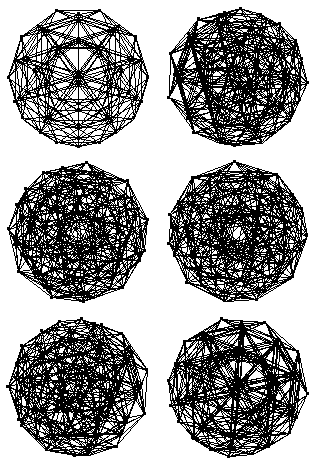
String art is a geometric art form that creates stunning visual patterns using only threads or strings wrapped around nails or pins placed on a board. This nail and string art technique, also known as pin and thread art, transforms simple materials into complex, beautiful designs through mathematical precision and artistic vision.
Originally developed in the 1960s by mathematician Mary Everest Boole, modern string art has evolved to incorporate advanced continuous line algorithms that optimize thread placement for maximum visual impact. Our string art generator utilizes sophisticated computational methods to analyze your photos and generate precise nail-to-nail sequences, making it accessible for both beginners exploring string art ideas and experienced artists creating professional string art patterns.
Whether you're working with traditional string art kits or creating custom string art designs, this ancient craft combines mathematical precision with artistic expression, resulting in unique wall art that captures light and shadow in remarkable ways.
For three years the Lazarus Initiative had existed in whispers and schematics. It promised not resurrection in the religious sense, but restoration — the reanimation of neural patterns from degraded tissue, the recovery of memory as a computational artifact. In a world where climate collapse, pandemics, and conflict had left countless lives shredded across databases and DNA banks, Lazarus was supposed to be a way to reclaim fragments of people: voices, decisions, the way they hummed a favorite song under their breath. The ethics committees had balked. The philanthropists insisted. The families begged.
The is more than just a utility; it is a mindset shift. In traditional operations, an engineer might say, "If the server dies, I will wake up and fix it." With Lazarus, you say, "If the server dies, the script will fix it for me, and I will review the log in the morning."
In the world of Lazarus, a popular Pascal-based programming language, scripts play a crucial role in automating tasks, enhancing functionality, and streamlining development. One script that has gained significant attention in recent years is the Project Lazarus Script. In this article, we'll delve into the world of Project Lazarus Script, exploring its features, benefits, and applications.
for i in $(seq 1 $MAX_RETRIES); do if systemctl is-active --quiet $SERVICE; then echo "✅ $SERVICE is alive." exit 0 else echo "⚠️ $SERVICE dead. Attempt $i of $MAX_RETRIES..." systemctl start $SERVICE sleep $SLEEP_TIME fi done


For three years the Lazarus Initiative had existed in whispers and schematics. It promised not resurrection in the religious sense, but restoration — the reanimation of neural patterns from degraded tissue, the recovery of memory as a computational artifact. In a world where climate collapse, pandemics, and conflict had left countless lives shredded across databases and DNA banks, Lazarus was supposed to be a way to reclaim fragments of people: voices, decisions, the way they hummed a favorite song under their breath. The ethics committees had balked. The philanthropists insisted. The families begged.
The is more than just a utility; it is a mindset shift. In traditional operations, an engineer might say, "If the server dies, I will wake up and fix it." With Lazarus, you say, "If the server dies, the script will fix it for me, and I will review the log in the morning."
In the world of Lazarus, a popular Pascal-based programming language, scripts play a crucial role in automating tasks, enhancing functionality, and streamlining development. One script that has gained significant attention in recent years is the Project Lazarus Script. In this article, we'll delve into the world of Project Lazarus Script, exploring its features, benefits, and applications.
for i in $(seq 1 $MAX_RETRIES); do if systemctl is-active --quiet $SERVICE; then echo "✅ $SERVICE is alive." exit 0 else echo "⚠️ $SERVICE dead. Attempt $i of $MAX_RETRIES..." systemctl start $SERVICE sleep $SLEEP_TIME fi done
This string art patterns generator builds upon the pioneering work of the open-source community and mathematical research in computational geometry:
MIT License - This project is open source and available under the MIT License.
Source Code: Available on GitHub Pages with full source transparency
Attribution: When sharing or modifying, please credit StringAr.com and maintain license notices
Commercial Use: Permitted under MIT terms - feel free to use for commercial string art projects
Our enhancements to the original algorithms include: